You’ve spent months, if not years, posting on social media. You post often. You’re consistent. You respond to comments. And you engage with others’ content. You keep gaining followers. You get plenty of “likes.” But after all that, you have no real business benefit to show for it.
That’s not an uncommon issue, especially for solopreneurs like freelance writers. I’d know not only because I’m a freelance pro myself, but because I’ve been helping other solopreneurs and creative professionals fix this very problem since the rise of modern social networks.
If you find yourself in this situation, the issue isn’t that you’re doing something wrong. It’s more likely something you haven’t thought about much yet: social media strategy. (And no, doomscrolling and constantly checking social network notifications is not a social media strategy.)
The good news is creating a social media strategy for your freelance writing business isn’t difficult. And it doesn’t have to take a long time. Read to the end, and I’ll even give you a one-page social media strategy worksheet you can use to get started today.
Before you get there though, let’s talk about some important fundamentals you’ll want to understand before you build out that strategy.
Standard Social Media Advice (& Why It Doesn’t Work for Freelancers)
Typical social media advice looks something like this: post consistently, post across all platforms where your target audience might be, engage rather than broadcast, be professional (or at least on-brand), track analytics, keep it authentic…
None of that is wrong. But it’s not designed with freelancers in mind.
Do you have a marketing team behind you? Someone to create social media graphics? Videos? Adapting your content to different platforms?
Probably not.
And you don’t need that. Just understand traditional business-oriented social media advice generally assumes you aren’t doing everything yourself. Too often, it focuses on scale more than substance.
Companies can afford to have teams work on social media content just for visibility’s sake. You probably can’t. Yet I frequently see fellow freelancers pretend otherwise.
Ultimately, it comes down to understanding your real business goals, how social media can directly impact them, and admitting you’re human and can’t do everything or be everywhere (and that’s OK!).
Building a Freelance Social Media Strategy that Sets You Up for Success
If you want to get more out of the time you put into social media (when you’re doing it all yourself), focus on simplicity first.
And when I say “simple,” I mean simple. You might need to scale back significantly before re-building around your new social media strategy. That might even be fighting your own instincts at first.
Keep in mind, my advice isn’t based on what’s worked for me. It’s based on 20+ years of experience working with many independent clients (freelancers, authors, musicians, artists, and one-person business owners across a wide variety of industries). It’s not “hey, this worked for me, so I’m sure it will work for you!” It’s more “this is what’s worked with hundreds of clients in similar positions to us.”
Do you know what the number one social media issue has been across those years, with nearly all of those clients? They try to do too much. The most effective strategy is nearly always scaling back to fewer social media platforms first, then moving forward (unless they’re not using social media at all yet).
So yes… keep it simple.
Remember, these platforms were designed to be addictive. They give you little dopamine hits that keep you scrolling, liking, posting, and coming back throughout the day. That’s partly why the vanity metrics (which we’ll get to shortly) exist.
It’s to make you feel like you’re actually doing or accomplishing something when the reality is a lot of the time people spend on social media, including professionally, has no significant business impact (especially for the time invested). And it makes you feel good when you see these numbers tick up for your account, or in response to your content, even when they don’t really matter.
Start here:
1. A Single Goal
What is your primary goal you want to build your social media strategy around?
One goal.
Do you want to attract prospects? Network with colleagues in a way that supports your business (not just friendly chit-chat, but in a way that actually leads to new work)? Promote content or products you offer in addition to services?
I know plenty of writers who try to do all of those things, from the same social media accounts. And I’ve yet to meet a single one who does so effectively. The ones most loudly proclaiming they’re the exception usually end up being the same writers ranting (often on social media) about how they don’t earn enough. Not exactly shocking.
Trying to do too much might make you feel like you’re being productive. But the reality is this leads to distractions, procrastination towards more efficient and effective ways to reach your goal, and confusion among the very people you’re trying to build relationships with.
Choose just one goal, especially at the start.
2. A Specific Target Audience
Your target audience or market will depend on your goal. Is it potential clients? Colleagues? New email subscribers for your owned list? Buyers or something else you offer? Again, if you’re using social media effectively, it’s not going to be all of these groups at the same time for the same social media profiles.
This is also a good point to think about how you’re using your social media accounts already, and who the more natural audience has been so far. If you want to land new clients, but you’re mostly chatting with colleagues (and they’re not the ones referring you work), something needs to adapt.
That might mean recognizing your current profiles aren’t in a good position to help you reach your goal. You could alter your approach there. Or you create dedicated profiles specifically for business use (a good idea anyway so it’s easier to stay away from personal accounts when you’re meant to be working).
3. A Primary Platform
Choose one primary social media platform you’ll build your social media strategy around. This is the main platform where you’ll create native posts (which you might, or might not, repurpose for use on other platforms to amplify content).
It does not matter if your audience uses multiple platforms. You don’t need to talk to the same people in different places, and doing so can dilute the value of the time you’re spending on social media.
Your primary platform shouldn’t be the one you personally enjoy using most. Save that for personal social media use, separate from your freelance social media strategy. Pick a primary platform based on where you’re most likely to find and connect with your target audience, in a way that helps you reach your professional goals.
That’s not to say you should only use one platform. This is the main one you’ll build your strategy around, where you’ll spend most of your professional social media time, and which can be amplified using other networks, content repurposing, and aligned strategies. But start with one, then build from there. In many cases, you’ll realize you don’t need to.
4. A Consistent Content Plan
When I say “consistent,” I don’t mean you need a strict schedule for posting to social media platforms. The value of that type of consistency has long been overrated and misleading in the broader new media space.
That advice targets people just starting out (and given the readers of this site, that probably isn’t you). The more content you’ve created and shared already, the less important strict consistency is because you have a collection of digital assets that continue to work for you whether you’re posting something new every day (or week), or not.
So when we talk about building a consistent content plan, forget about what you’d like to post, and what you think you need to commit to. Focus on consistency in terms of what you can turn into a habit (a healthy and productive one… not the consumption side of social media).
This might very well mean starting much smaller than you think you should.
I’d recommend that with the start of any new strategy. It gives you time to test, see what works, see what kind of time commitment certain post types require, and then you adjust or add on from there.
Have a rough schedule in mind. But remember consistency isn’t just about schedules. It’s much more important that the quality of what you share is consistent (whether that’s graphics, thought leadership pieces, etc.) than that you push yourself to follow some strict, usually arbitrary, schedule.
Build a Social Media Strategy You’ll Stick To
Speaking of consistency and schedules…
Plan for Your Worst Week, Not Your Best
I get it. When you’re building out a new strategy, it can be exciting thinking about reaching those goals. But if you want to get there, add a little realism to your ambition.
Map out what an ideal week or month looks like to you. How many posts? Where? Images? Think-pieces? Brief posts?
Then think about some of your roughest weeks. If you have a busy family schedule, chronic illness, or other commitments that can battle for your attention, what can you realistically still do in your social media marketing when things aren’t ideal?
Plan around those rougher weeks first. Figure out the minimum amount you can do to still reach your goals and feel good about what you’ve accomplished. Make that your base commitment.
That doesn’t mean you can’t do more. But that “more” becomes a bonus, and missing overly-ambitious targets won’t leave you feeling discouraged.
Batching Social Media Content Creation
Another quick tip to help you build a social media strategy you’ll be able to stick to is to batch your tasks.
I’m a big fan of task-batching in general. It’s why I have a day each week dedicated to admin work alone. You can use that strategy to keep you posting consistently (timewise and quality-wise) while also preventing you from spending too much time on social media platforms themselves.
This might mean brainstorming, writing, and scheduling posts for a week all on one day, with minimal check-ins beyond that. Set times to check and respond to comments, have very limited notifications let you know when a response is needed, then do that once a day, etc.
You can even batch image creation. We recently looked at some Canva Pro features, including their bulk create tool, that help you make quicker work of your templates. For example, maybe you want to post insightful tips or quotes periodically. You can upload that text via Canva’s bulk create tool, map it to the text area of your graphic templates, and batch-create images you can schedule once and not have to worry about again.
More deliberate social media work that aligns with your strategy. Less “I’ll just log on to whatever platform and see if the urge to post or comment strikes me.”
Measure Business Impact Instead of Vanity Metrics
A freelance social media strategy only matters if it helps you reach your main business goal. And that requires tracking and measurement. But a common mistake is tracking the wrong things.
Followers, likes, shares… those are not the things to track.
Those are vanity metrics. They’re ego-driven, desperate grasps at false validation and fake popularity. They require next to no effort. And they mean practically nothing.
The metrics you want to track depend on your goals.
For example, these days I prioritize LinkedIn, not to find clients, but to promote digital properties. And LinkedIn has been an excellent tool to drive email subscriptions on those sites (using “company” pages for each property). New email signups coming from those LinkedIn posts is a metric worth tracking, as is direct traffic going from LinkedIn posts on those company pages to the owned properties.
If your goal is to land a certain number of new clients each month from social media, you might track metrics like DMs and emails from prospects on those platforms, how many people visit your website from your social media posts, and, of course, how many actual conversions you have each month (from social media posts to new clients).
These are the kinds of metrics that matter. The rest is what shoddy social media “pros” convince their clients to track because easily-manipulated vanity metrics help them justify their own existence (and what they charge).
When you put together your social media strategy, remember that everything stems from your primary goal. That includes the metrics genuinely worth tracking.
Let’s move on and start building your new social media strategy…
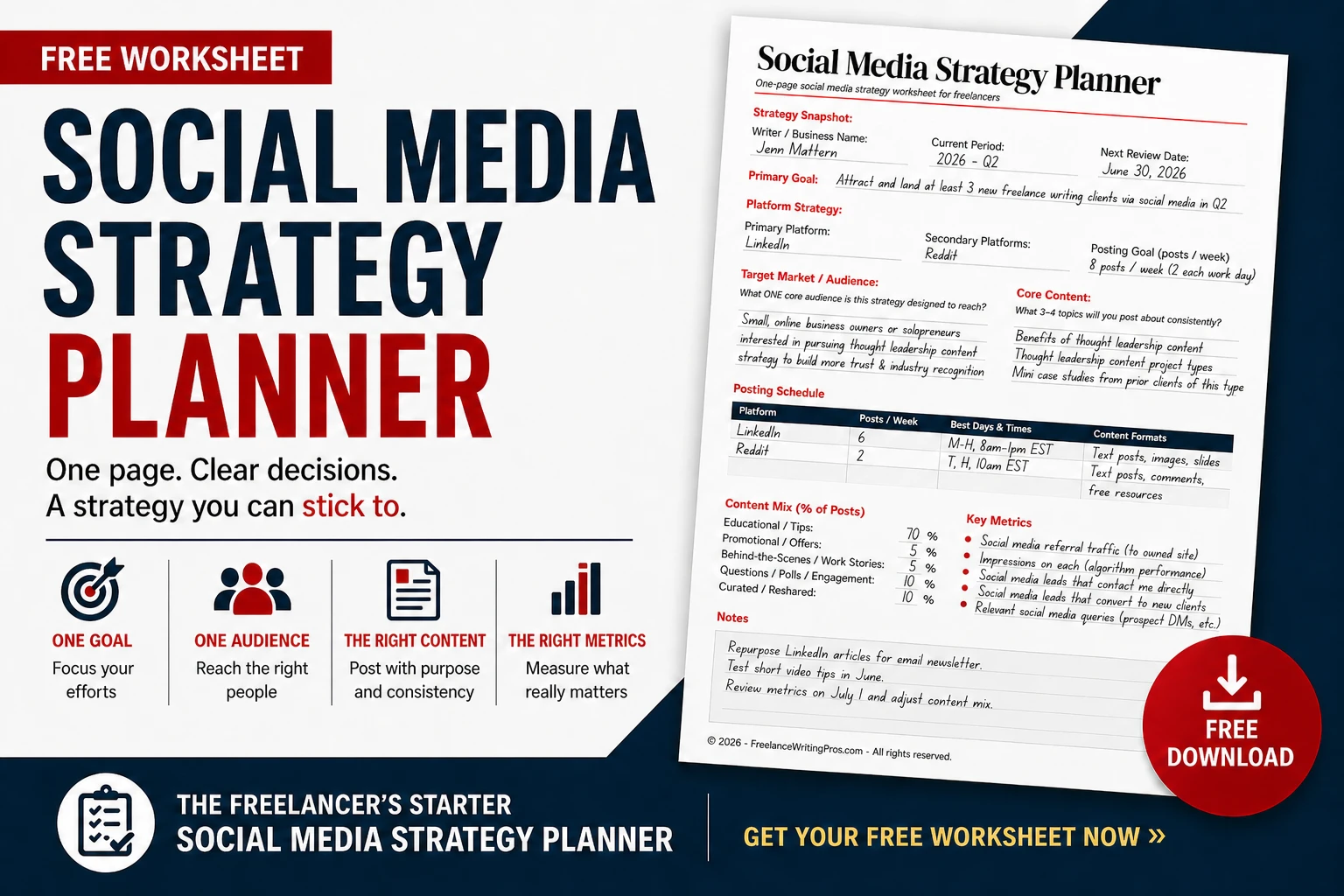
Free One-Page Social Media Strategy Worksheet
While comprehensive social media strategies (the kind companies pay at least low five-figures for) are the ideal, freelancers don’t need to go that in-depth at the start. That’s why I put together a simple one-page social media strategy planner worksheet designed to help you think through the basics and get a plan on paper.
I will follow this up with a more premium guide to walk you through all the more advanced decisions and processes. But for now, this free worksheet gives you some direction. Plus, it’s easy to keep a one-page strategy document at easy reach when you need a reminder of how you planned to spend your time on social media.
Here’s a filled-out version to show you what it might look like if attracting clients is your social media goal. It shows you what kinds of metrics you might track in that case, and how detailed you want to be (SMART goals, how you describe your target market, etc.).
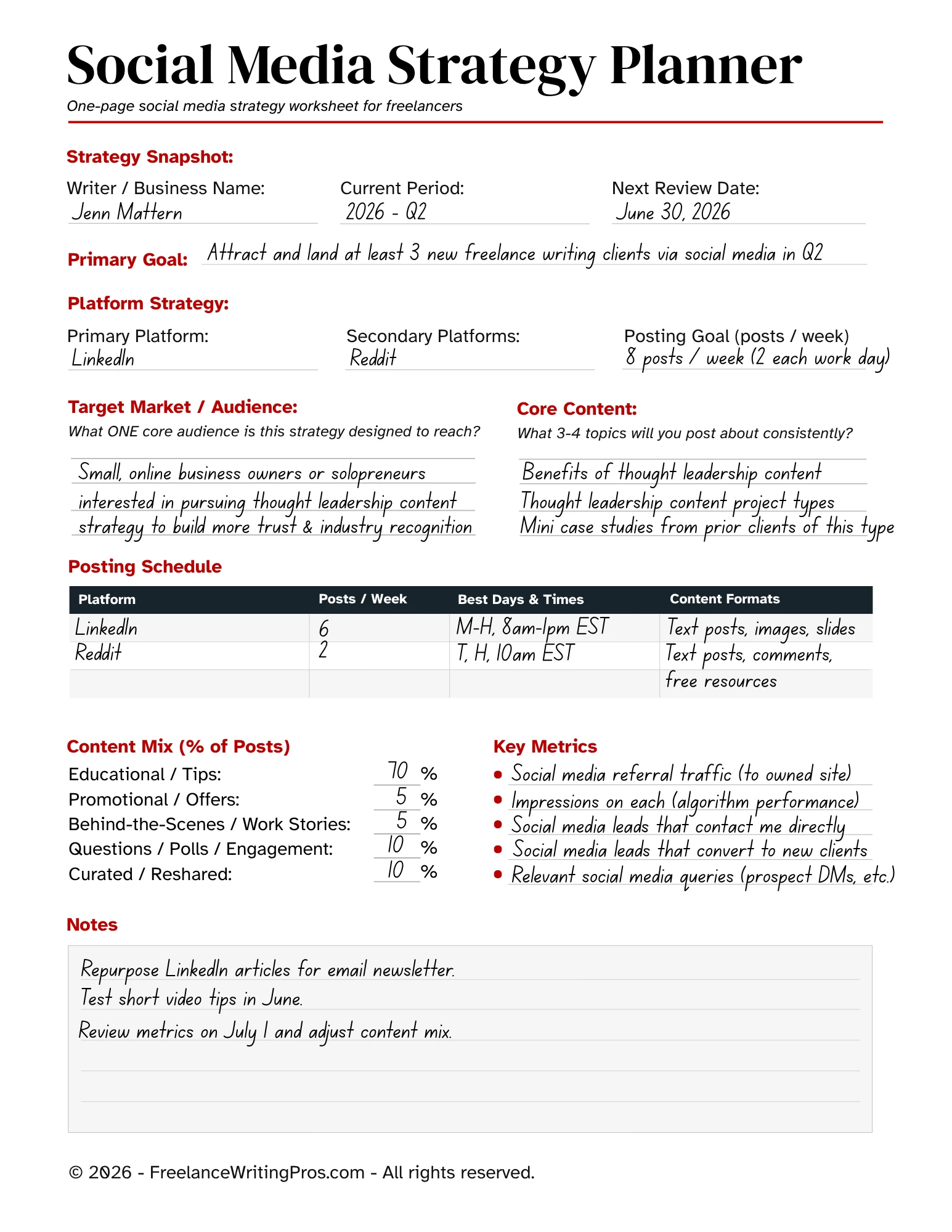
If you’d like to use this free printable social media strategy planner worksheet, designed with freelancers in mind, download it now.
This will help you define and document your strategy before you get (or stay) too caught up in posting content that doesn’t really drive business results.
Fill the worksheet out. Then review it periodically (I’d recommend monthly at first until you figure out what works best, then doing a quarterly review). Make adjustments as your business changes or when the metrics that really matter tell you something isn’t working.